
Machine learning solutions comprise artificial intelligence algorithms that help detect patterns in data, make predictions, and perform decision-making functions. Businesses leverage their predictive and analytical capabilities to automate operations, uncover insights, and make accurate forecasts.
Machine learning solutions are typically software systems that use artificial intelligence algorithms to recognize patterns in data, make predictions, and perform a wide range of decision-making functions. Unlike traditional programming, the solutions utilize mathematical algorithms to allow computers to make decisions or undertake actions based on observed patterns, trends, or probabilities.
Businesses and organizations have adopted the technology to transform their data analysis and decision-making processes. Some of the most common use cases include fraud detection and predictive maintenance. However, developing an effective ML system requires professional expertise in computer science and access to appropriate data resources. This is why enterprises often hire a machine learning engineer or a qualified team to handle such projects.
Machine learning solutions are systems that use statistical algorithms to detect patterns in data. In general, the term refers to computer programs that utilize data to make predictions, recommendations, and decisions. Spam detection, recommendation systems, smart speakers, and automated trading are some of the common use cases of machine learning solutions.
Core components
Data processing: data mining, preparation, collection, and analysis,
Model construction: model training and design,
Testing and validation,
Deployment and monitoring.
The technology is different from traditional software systems in several ways. First, unlike conventional computer programs, ML solutions do not follow a set of instructions (hard-coding). Instead, they rely on data to train themselves. Second, while ordinary programs give the same output after deployment, ML solutions continue to learn and improve their performance automatically.
Modern enterprises face a wide range of data-related challenges that require the scalability, efficiency, and accuracy of artificial intelligence to resolve. Traditional data processing and analysis methods have limited capacity, making businesses unable to respond to the needs of modern data-driven decision-making. In many cases, algorithms can uncover insights and patterns that humans fail to discover. Here are some of the main reasons why businesses need machine learning solutions:
ML solutions allow businesses to process large amounts of data faster and use the findings to make decisions. In many cases, the model can produce results within hours or even minutes.
Since most ML algorithms require data to operate, the more examples an algorithm observes, the better it becomes at making accurate predictions. The self-learning nature of these solutions also contributes to their accuracy and reliability.
Machine learning algorithms can handle simple, repetitive, and rule-based tasks, leaving humans to tackle more complex issues.
Firms and businesses can use the solutions to obtain valuable insights about their customers, suppliers, and business processes and stay ahead of competitors.
Most machine learning solutions involve developing a model that helps make predictions and decisions. In general, the process starts with defining the problem, followed by collecting and analyzing data insights. The next step is to select an appropriate ML algorithm, develop a prototype, test the model, and deploy the final solution. The complete process requires the expertise of a professional team of machine learning developers and data scientists. This is why most enterprises that want to implement the solutions outsource the project to a reliable organization that offers end-to-end services in developing an ML model.
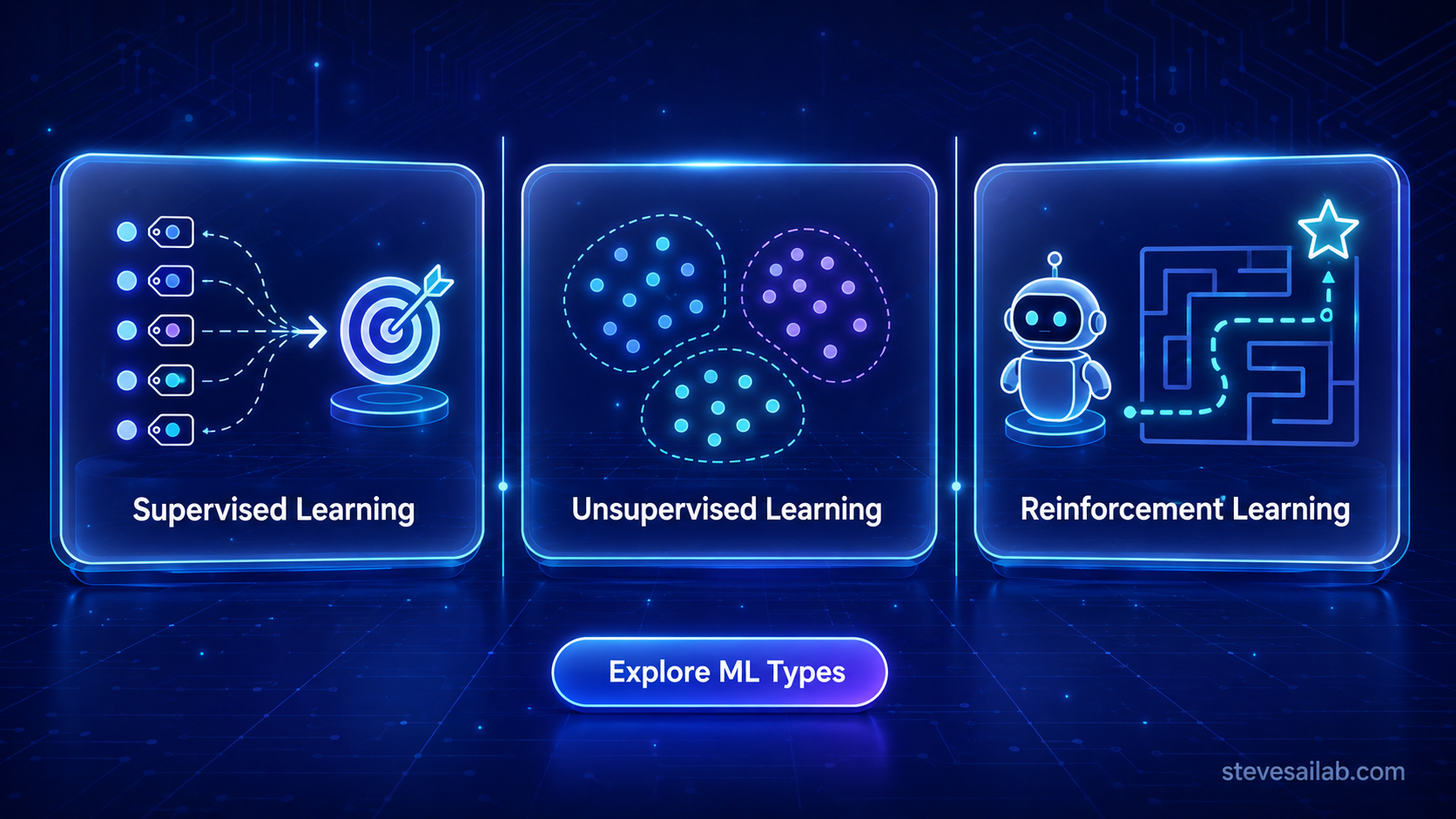
The broad term ‘machine learning’ refers to a wide range of algorithms that fall under three main categories, including supervised learning, unsupervised learning, and reinforcement learning. Within the three main categories, various techniques exist, many of which have distinct requirements and use cases. For instance, deep learning uses neural networks to perform complex decision-making functions. The table below contains the key features of the main three types of ML solutions:
Type Definition Use Cases
Supervised learning
The process of training ML models using labeled data. In other words, the algorithm learns from the relationship between the inputs and outputs.
Fraud detection, credit scoring
Unsupervised learning
The process of training ML models using unlabeled data. The algorithm draws conclusions from the underlying patterns in the data.
Customer segmentation
Reinforcement learning
The process of training ML models to make decisions by rewarding the algorithm with points (rewards) for every correct decision.
Robotics, dynamic pricing
Companies that are new to machine learning usually work with an established enterprise to develop the best-fit project. In most cases, the initial step is to conduct a discovery to identify the most suitable solution. A discovery process consists of a series of steps, including analyzing the data and determining the expected value. The next step is to perform a proof of concept – a process that evaluates whether to proceed with the full-scale development or abandon the machine learning project. After a successful proof of concept, enterprises can proceed to the next phase, which is the development of a full-scale working solution.
Many organizations have adopted artificial intelligence (AI) to remain competitive, and machine learning plays a pivotal role in such initiatives. These companies usually work with an AI partner to develop end-to-end solutions for their application or platform. The process typically involves deploying various solutions, including natural language processing or computer vision, to design end-to-end integrated systems. In general, enterprises can benefit from custom AI software development companies that offer AI solutions tailored to their business goals.
When looking for an ML partner, it is essential to consider their experience and track record in the field. Ideally, a reliable organization should have a proven track record of delivering successful ML solutions, preferably in your sector. Experience is a critical indicator of the ability of an ML company to deliver quality solutions. Other crucial factors to consider include whether the company provides ongoing support after launch and if the business offers transparent evaluation reports to help you understand how well the model works. A competent organization will be willing to provide all such information to help you get the most value for your investment.
Machine learning solutions allow businesses to make accurate predictions and transform their decision-making processes, therefore enhancing their performance and competitiveness. The technology is now used in almost all fields and aspects of life that require data analysis. In general, most ML processes require experienced programmers and reliable data sources. Enterprises that want to implement the solutions to gain insights and improve performance should first consider a use case that will benefit the most from adopting the technology.
They are generally applied to problems of fraud detection, demand forecasting, recommendation systems, and predictive maintenance. Companies use solutions for any business task that involves analyzing large amounts of data for patterns too complex to be practically analyzed by humans or traditional software.
In the majority of cases, yes. A professional with expertise in developing and designing data pipeline systems is required to build a working model. Experience in the field is crucial to building reliable and accurate solutions since the creation of machine learning solutions is not a standard software development process.
Traditional computer programs operate under hard-coded rules. Meanwhile, machine learning solutions can adapt and adjust their behavior based on patterns they identify in the data. Therefore, such solutions are typically better at tasks that involve prediction and detection.
The more data, the better, although the specific amount depends on the type of model and the specifics of the problem. Many companies invest in machine learning consulting services to determine if they have enough data to train their machine learning models.
Several weeks may be enough to design a basic solution. However, building a robust machine learning solution that can be integrated into an existing business infrastructure requires several months of work.
We help US enterprises make this decision based on their specific workload requirements, existing infrastructure, and long-term AI roadmap - not platform preference.
Get expert insights on your use case and identify the most effective path forward.