
Project Overview
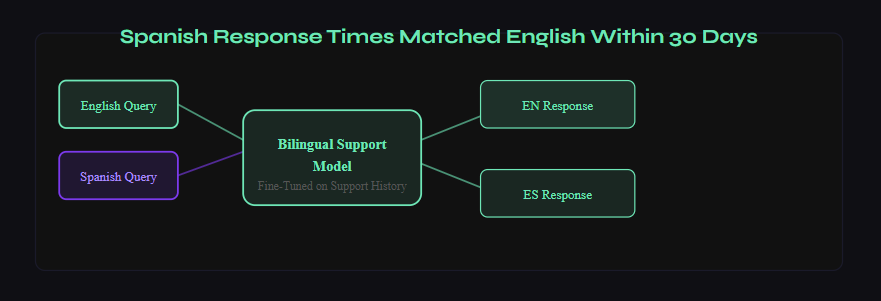
A US e-commerce brand had a growing Spanish-speaking customer base and a support operation that was not keeping up with it. Spanish-language queries were taking three times longer to respond to than English queries because no Spanish-speaking support staff were available. Customer satisfaction scores for Spanish-language contacts were significantly lower than for English contacts. We fine-tuned a foundation model on their full support history in both languages to handle Spanish customer queries with the same accuracy, tone, and brand voice as their English support operation, without requiring any additional headcount.
The Challenge
The brand’s customer support team was English-only. When Spanish queries arrived, the team routed them to a shared inbox where they waited until a bilingual contractor was available, which was not reliably fast. The result was a structural two-tier support experience where Spanish-speaking customers received measurably worse service than English-speaking customers, which was visible in their satisfaction scores and return purchase rates.
- Spanish-language queries had an average response time three times longer than English queries
- Customer satisfaction scores for Spanish contacts were significantly lower than for English contacts
- No Spanish-speaking support staff on the team meant any solution required either hiring or a technology-based approach
- Generic translation tools were not acceptable: brand voice, product-specific terminology, and tone all needed to carry accurately in Spanish context, not just linguistically
- Evaluation of outputs required native speaker review before deployment, which added a quality gate the team had to resource
Our Solution
We fine-tuned a foundation model on the brand’s full support ticket history in both English and Spanish, including resolution notes and satisfaction scores, to create a bilingual support model that could handle Spanish queries with the same fidelity to brand voice and product knowledge as their English support operation. The model was not a translation layer on top of an English model: it was trained to operate natively in both languages from the same fine-tuned base.
- Bilingual Training Corpus: We compiled and cleaned the brand’s complete support history in both languages, stratifying by query type, resolution path, and satisfaction outcome to ensure balanced representation across the training dataset.
- Brand Voice and Terminology Alignment: We worked with the support team to document product-specific vocabulary and brand tone guidelines in both languages. These were incorporated into the instruction-tuning format to anchor model outputs to the brand’s voice rather than generic customer service language.
- Native Speaker Evaluation: Before deployment, model outputs across a held-out test set were reviewed by native Spanish speakers for tone, accuracy, and product terminology fidelity. Several rounds of refinement based on reviewer feedback preceded final deployment.
- Routing Integration: Spanish queries were routed automatically to the model, with a human review step retained for edge cases and escalations flagged by the model.
Technical Approach
The model was fine-tuned on a bilingual instruction dataset built from the brand’s support history, with each training example structured as a customer query paired with a high-quality resolution response. Query and response pairs were filtered by satisfaction score to bias training toward the resolution patterns that produced the best customer outcomes. The model ran as an API-integrated service connected to the brand’s existing support ticketing platform, with automatic language detection routing Spanish queries to the bilingual model and English queries to the existing English-only system.
Results & Impact
- Spanish response times matched English response times within the first month of deployment, eliminating the three-times gap that had existed previously
- Customer satisfaction scores for Spanish-language contacts equalized with English scores in the months following deployment
- No additional support headcount was required to achieve response time parity: the model handled the Spanish query volume that had previously been bottlenecked on contractor availability
- The brand was able to serve a growing Spanish-speaking customer segment without a corresponding increase in support operating costs
Lessons Learned
Generic translation was not an acceptable solution here, and the native speaker evaluation process confirmed why. Several outputs that passed automated quality checks were flagged by native speaker reviewers for tone issues that were subtle but would have felt off to a Spanish-speaking customer. The investment in native speaker evaluation before deployment was not optional: it was the quality gate that made the model trustworthy enough to deploy without a human in the loop on every response. Brand voice transfer across languages is harder than it looks when it is described in writing, and the iterative refinement based on reviewer feedback was what closed the gap between technically accurate and genuinely on-brand.