
Project Overview
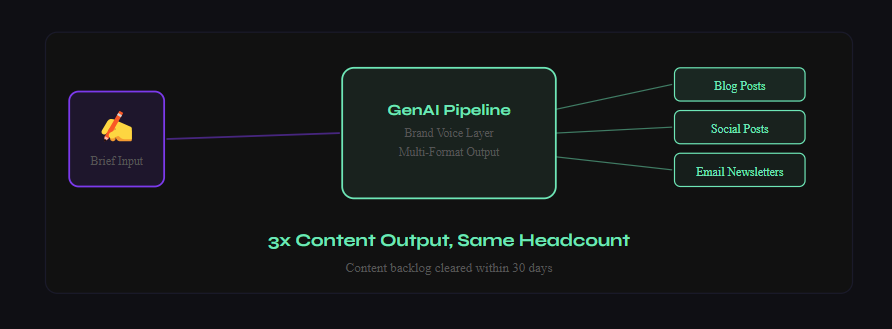
A US B2B company with a growing product lineup had one marketing hire responsible for all content across the business. Blogs, social media posts, weekly email newsletters, and product copy across three product lines all fell to one person. The content calendar was permanently behind, quality was inconsistent under the volume pressure, and the marketing hire was spending almost all of her time writing first drafts rather than doing the strategic work the role was hired for. We built a generative AI content pipeline trained on their brand voice that produced structured first drafts for every content type from a simple brief input, giving her back the time she needed to do the work that actually required human judgment.
The Challenge
The problem was not a lack of effort. It was a structural mismatch between what one person could produce and what the business needed. Every piece of content started from a blank page. There was no reuse system, no template structure beyond rough outlines, and no way to scale output without scaling headcount.
- One marketing hire responsible for four content types across three product lines with no production support
- Content calendar running two to three weeks behind on a consistent basis
- No structured brand voice documentation that could be used to brief a contractor or an AI system
- Leadership wanted to increase content output by three times in the coming quarter without adding headcount
Our Solution
We built a generative AI content pipeline with the brand voice layer at its center. Before any generation could work reliably, we worked with the marketing hire to document the company’s tone, vocabulary preferences, structural patterns, and quality standards in a format the system could use as a persistent generation context.
- Brand Voice Documentation: We ran a structured workshop with the marketing hire to extract and encode the company’s tone, preferred phrasing, content structure patterns, and quality standards into a reusable brand voice profile.
- Multi-Format Generation Templates: Separate generation templates for each content type, each with format-specific instructions, section structures, and length guidelines baked in.
- Brief Input Interface: A simple form where the marketing hire enters the topic, key points, target audience, and any specific requirements, and receives a structured first draft within minutes.
- Human Review Step: Every draft goes through a quick review before use. The pipeline was designed to reduce writing time, not remove human judgment from the process.
Technical Approach
The pipeline was built on a Node.js backend using the OpenAI API with a persistent brand voice system prompt injected into every generation request. Format-specific templates were stored as structured prompt components that combined with the brand profile and the brief input at generation time. The interface was a lightweight React form requiring no technical knowledge to use. Total generation time per piece was under two minutes from brief submission to first draft delivery.
Results & Impact
- Content output tripled within the first month with the same single marketing hire, no contractors or additional headcount added
- Content calendar backlog cleared within 30 days of the pipeline going live
- The marketing hire shifted the majority of her time from first-draft writing to strategy, editing, and distribution, which was the original intent of the role
- Four content types covered by a single pipeline with shared brand voice enforcement across all outputs
- Content quality became more consistent across types as the brand voice documentation eliminated the variation that came from writing under time pressure
Lessons Learned
The brand voice documentation workshop was the most important session in the entire project and the one most likely to be skipped if we had not insisted on it. The marketing hire assumed the brand voice was obvious and did not need to be written down until we started asking specific questions and discovered that even she was inconsistent on tone and vocabulary between content types. That documentation session improved the consistency of her own manual writing as a side effect, independent of anything the AI produced.