
Project Overview
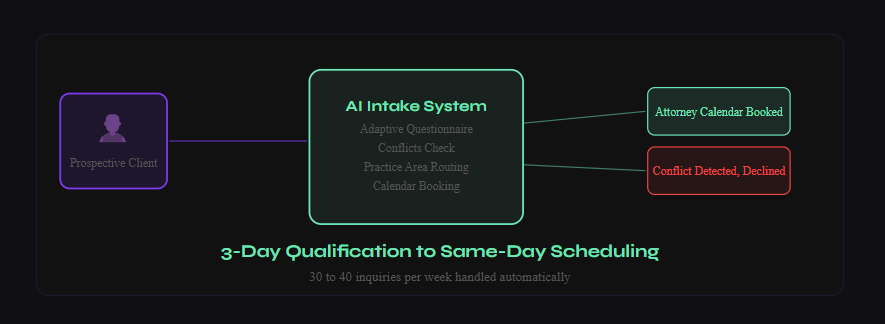
A small US law firm was losing potential clients before the first conversation even happened. The firm received 30 to 40 inquiries per week through their website contact form and phone line. Each inquiry required a paralegal to follow up, collect basic case information, check for conflicts of interest against the firm’s existing client database, determine whether the matter fell within the firm’s practice areas, and route the qualified inquiry to the appropriate attorney for a consultation. The full process was taking 2 to 3 days per inquiry. By that point, many prospective clients had already contacted another firm. We built an AI-powered client intake system that handled the full qualification and scheduling flow on the firm’s website, reducing the time from first inquiry to booked consultation from days to hours.
The Challenge
The intake problem had several layers that a simple contact form upgrade could not address. The firm handled matters across multiple practice areas, each requiring different preliminary information. A personal injury inquiry needed different information than a contract dispute or an employment matter. A static form that tried to cover all cases asked too many irrelevant questions for most clients and still missed critical information for others.
- 30 to 40 weekly inquiries each requiring manual follow-up by a paralegal before qualification could begin
- 2 to 3 day average time from inquiry to consultation booking, during which prospective clients were frequently contacting competing firms
- Multiple practice areas each requiring different intake information with no smart routing logic in the existing process
- Conflicts of interest checks being done manually by the paralegal against a client database, adding time and introducing human error risk
- The system needed to stay strictly within information gathering. Any output that could be interpreted as legal advice was unacceptable regardless of how the question was phrased
Our Solution
We built an AI-guided intake application embedded directly in the firm’s website that replaced the static contact form with an adaptive conversational flow. The system collected all necessary preliminary information, ran an automated conflicts check, routed qualified inquiries to the right attorney, and offered direct calendar booking for the consultation, all within a single session.
- Adaptive Questionnaire Engine: An intake flow that branched based on the prospective client’s responses, asking only the questions relevant to their specific matter type. A personal injury inquiry triggered a different question path than an employment or contract matter, collecting the right information without overwhelming the client with irrelevant questions.
- Automated Conflicts Check: Integration with the firm’s client database running an automated conflicts of interest check against the information provided during intake. Potential conflicts were flagged immediately and routed to the managing partner for review rather than proceeding to scheduling.
- Practice Area Routing: Logic that classified the matter based on intake responses and routed the completed intake to the appropriate attorney, with a structured summary of the prospective client’s information attached.
- Calendar Integration: Direct integration with the firm’s scheduling system allowing qualified inquiries to proceed immediately to consultation booking without requiring further paralegal involvement.
- Legal Advice Guardrails: Every question and every system response was designed and reviewed to remain strictly within information gathering. The system collected facts. It offered no opinions, assessments, or guidance that could be construed as legal advice.
Technical Approach
The intake application was built as a Next.js web application with a Node.js backend handling the conflicts check API calls and calendar integration. The conversational flow logic was built as a structured decision tree with dynamic branching rather than a free-form LLM conversation, which gave the firm complete visibility and control over every question the system could ask and every response it could display. The conflicts check integrated with the firm’s existing client management software via API. The calendar integration connected to the attorneys’ existing scheduling platform. The legal advice guardrail review was conducted by the firm’s managing partner before deployment, with every possible system output approved in writing before going live.
Results & Impact
- Intake qualification time reduced from 2 to 3 days to same-day for the majority of inquiries, with consultations frequently booked within hours of the initial contact
- 30 to 40 weekly inquiries handled through the automated system without paralegal involvement in the initial qualification step
- Paralegal hours recovered from routine intake work were redirected to active case support, which the firm had identified as a higher-value use of their time
- Inquiry to consultation conversion rate improved as the reduced time between contact and booking decreased the window during which prospective clients sought alternatives
- The structured intake data collected by the system gave attorneys better pre-consultation preparation than the previous informal paralegal notes, improving the quality of initial consultations
Lessons Learned
The decision to use a structured decision tree rather than a free-form LLM conversation for the intake flow was the right call for this specific context, even though it required more upfront design work. The firm needed to be able to review and approve every possible question and response before deployment. A free-form LLM could have produced a more natural conversation but would have introduced unpredictability that a legal practice cannot accept. The structured approach gave the firm complete control and made the compliance review straightforward. For applications where regulatory or professional responsibility concerns require exact control over system outputs, structured logic with human-approved response sets is often the more appropriate architecture than a generative conversational approach, even when the generative approach would produce a better user experience in other contexts.