
Project Overview
A Fortune 500 technology company with a direct enterprise sales organization of 180 reps engaged Steves AI Lab to address a specific productivity problem: reps were losing significant time each week searching across disconnected knowledge sources: product documentation, CRM notes, competitive intelligence briefs, and pricing guides, to prepare for prospect conversations and respond to mid-deal questions.
The Challenge
The company’s knowledge was spread across five separate systems: a product wiki, Salesforce CRM, a SharePoint competitive intelligence library, an internal pricing tool, and a legacy deal history database. Reps navigated all five manually, often spending 30 to 45 minutes preparing for a single prospect call or drafting a response to a technical question in an active deal.
- Five disconnected knowledge systems with no unified query interface
- Estimated 4 to 6 hours per rep per week lost to knowledge retrieval and manual synthesis
- Inconsistent deal preparation quality across the sales team
- New reps taking 3 to 4 months to reach full productivity due to knowledge ramp time
Our Solution
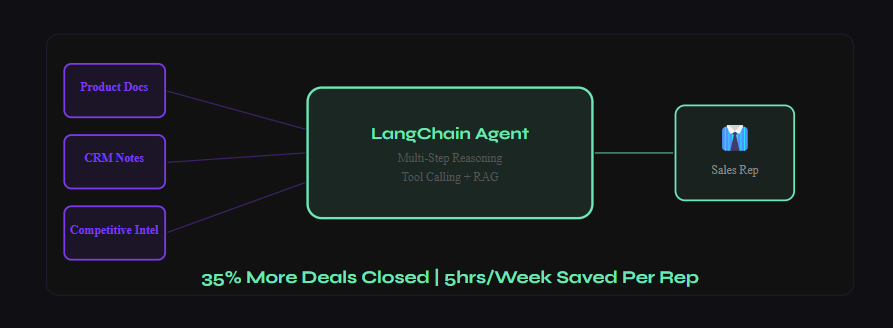
We built a LangChain-powered knowledge assistant that unified all five data sources into a single conversational interface accessible to every rep. The assistant could answer natural-language questions about product capabilities, retrieve relevant CRM deal history, surface competitive positioning guidance, and generate draft responses to prospect objections, all in a single query.
- Multi-Source Data Connectors: We built connectors to ingest and index content from all five knowledge systems, with incremental sync to keep the assistant current as documentation and CRM data were updated.
- LangChain Agent with Tool Use: The assistant was built as a LangChain agent with access to multiple retrieval tools, one per knowledge source, allowing it to decompose complex questions into sub-queries across relevant sources and synthesize a unified response.
- Salesforce Integration: The assistant had read access to Salesforce deal data, allowing reps to ask account-specific questions like “What objections came up in our last three calls with this prospect?” and receive synthesized answers from CRM notes.
- Objection Response Generator: A specific workflow was built for generating prospect-ready objection responses, pulling from competitive intelligence and product documentation to produce structured talking points the rep could use immediately.
Technical Approach
The system was deployed on GCP with a private VPC, connecting to Salesforce via OAuth, SharePoint via the Microsoft Graph API, and the legacy deal database via a custom read-only ETL. Vector embeddings were stored in Weaviate with metadata filtering that allowed queries to be scoped by product line, deal stage, or knowledge source type.
The LangChain agent used a ReAct (Reasoning and Acting) prompting pattern to decompose multi-part questions, decide which tools to invoke, and synthesize cross-source responses. Response latency averaged 4 seconds for single-source queries and 8 to 12 seconds for complex multi-source queries requiring multiple tool calls.
Results & Impact
- 35% increase in deal close rate in the six months post-deployment, attributed in part to improved preparation quality and faster response to prospect questions mid-cycle
- 5 hours per week saved per rep on knowledge retrieval and synthesis tasks
- New rep ramp time reduced from 3.5 months to 6 weeks: new reps could access the full breadth of institutional sales knowledge from day one
- Usage of the assistant correlated with win rate at 0.73 correlation coefficient across the 180-rep sales organization
- Competitive positioning accuracy in deal documentation improved, reducing instances of reps using outdated competitive comparisons
Lessons Learned
The LangChain agent architecture allowed us to add new knowledge sources incrementally without rebuilding the core system. When the sales team added a new pricing tier structure mid-deployment, we added a new pricing tool to the agent’s tool set and updated the index without disrupting existing functionality, a flexibility that proved critical as the organization’s knowledge base continued to evolve.
Rep adoption was driven almost entirely by the quality of the first experience. We invested heavily in ensuring the assistant returned accurate, immediately actionable responses in the first two weeks of deployment. Early inaccuracies in a tool like this would have killed adoption permanently. Establishing a feedback loop where reps could flag inaccurate responses, and seeing those addressed within 48 hours, built the trust that sustained long-term daily usage.