
Project Overview
A small US technology startup building AI features into its product had set up its cloud infrastructure quickly, prioritizing speed over efficiency. By the time they came to us, their monthly cloud bill was growing faster than their revenue. No monitoring was in place, and the team had no visibility into which resources were responsible for which costs or when usage was spiking. We were brought in to diagnose the problem and restructure their infrastructure for both cost efficiency and operational control.
The Challenge
The original infrastructure had been stood up by a developer focused on getting features shipped, not on building a sustainable cost structure. This left the startup with compounding problems they could not easily unwind on their own.
- Monthly cloud costs growing faster than revenue, with no clear ceiling in sight
- No resource tagging or cost attribution in place, making it impossible to identify which services and workloads were responsible for which spend
- No monitoring infrastructure of any kind: the team had no awareness of usage spikes until the bill arrived
- Compute resources provisioned at fixed sizes regardless of actual demand, resulting in consistent overspend during low-traffic periods
- No auto-scaling policies, meaning traffic spikes required manual intervention or caused degraded performance
The absence of cost attribution was the most significant blocker. Before any targeted optimization could happen, we needed to rebuild visibility from scratch. Without knowing which workloads were driving the bill, any reduction effort risked touching the wrong resources.
Our Solution
We started with a full infrastructure audit to map every running resource, its cost, and its relationship to actual workloads. From there we implemented a structured set of changes across compute, scaling, and observability.
- Full Infrastructure Audit: We inventoried every resource in the environment and mapped costs to specific services and usage patterns, establishing the cost attribution layer that had been missing from the start.
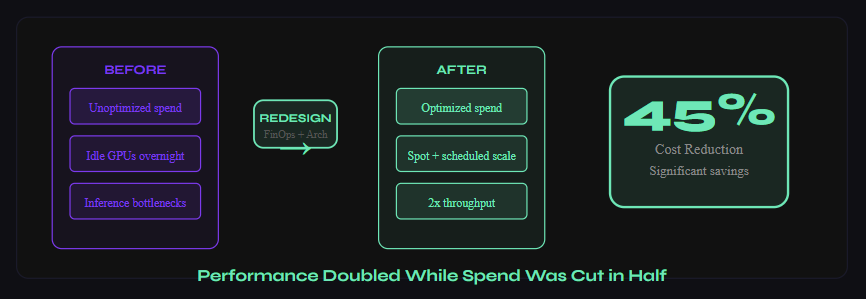
- Right-Sizing Compute: We identified and corrected over-provisioned instances across the stack, aligning resource allocation to actual usage profiles rather than worst-case assumptions.
- Auto-Scaling Policies: We implemented auto-scaling across the startup’s compute layer so resources scale up under load and scale back down automatically, eliminating waste during low-demand periods and removing the need for manual intervention during spikes.
- Spot Instance Migration: Where workloads allowed, we moved appropriate jobs to spot instances with proper interruption handling, reducing compute costs on those jobs significantly.
- Real-Time Cost Monitoring and Anomaly Alerts: We deployed a cost monitoring layer with automated alerts configured to trigger on anomalies, giving the team early warning when spend deviated from expected patterns rather than discovering it at month end.
Technical Approach
The cost attribution rebuild was the prerequisite for everything else. We applied a consistent resource tagging schema across all infrastructure, enabling spend to be broken down by workload, environment, and feature area. This tagging structure fed into a real-time cost dashboard that surfaced daily spend visibility for both the engineering and operations teams.
Auto-scaling was implemented using the cloud provider’s native scaling capabilities, tuned to the startup’s actual traffic patterns rather than generic defaults. Scaling thresholds were set conservatively at first and adjusted after two weeks of monitoring data confirmed the patterns we had identified during the audit. Spot instance workloads were made checkpoint-aware so interruptions did not result in lost progress.
Results & Impact
- Monthly cloud bill reduced significantly without any degradation in application performance for end users
- Auto-scaling handled traffic spikes without manual intervention, removing a recurring operational burden from the engineering team
- Real-time cost monitoring alerts gave the team early warning on future anomalies, replacing the end-of-month billing surprise with ongoing visibility
- Full cost attribution in place for the first time, enabling the team to make informed decisions about resource allocation going forward
Lessons Learned
The most important lesson from this engagement was that cost optimization cannot begin without cost visibility. The startup had tried to reduce spend before but could not make progress because they did not know where the money was going. Rebuilding the attribution layer first, even though it added time before any actual cost reduction appeared, was the decision that made everything else possible.
The auto-scaling implementation also reinforced a pattern we see frequently: teams avoid auto-scaling because they fear instability, but static over-provisioning creates a different kind of instability, the financial kind. Once the team saw auto-scaling handling spikes cleanly in a staging environment, confidence in moving it to production was straightforward to build.